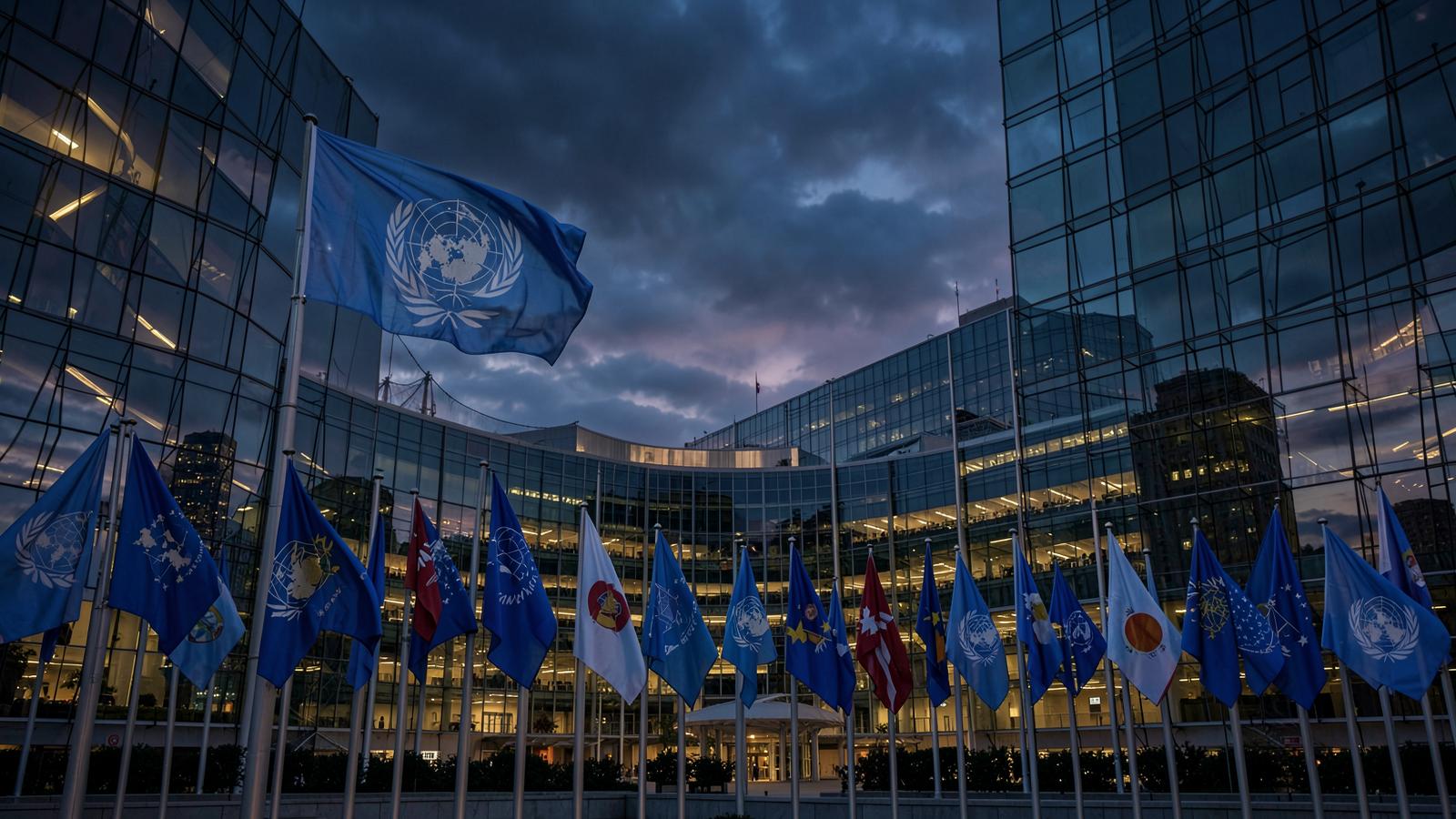
From Addis Ababa to Sana'a, from Gaza to Khartoum, the same bitter question is asked whenever the world fails to stop a war: does the United Nations exist to protect all nations equally — or does it, in practice, serve the handful of powers that dominate world affairs and the global economy?
This article does not answer that question for you. Instead, it lays out the strongest version of each case, with the evidence each side actually uses, so readers can weigh them honestly.
The case that the UN serves the powerful
Critics — and they include many governments in Africa, the Middle East and the Global South — build their argument on hard structural facts, not rhetoric.
1. The veto is written into the Charter
Five states — the United States, Russia, China, the United Kingdom and France — hold permanent Security Council seats and can each block any substantive resolution. Between 1946 and today the veto has been cast hundreds of times, overwhelmingly to protect the interests or allies of the permanent members themselves. No other arrangement in any major international body gives a small club of states a legal right to stop collective action. For critics, this is not a flaw in the system; it is the system working as the victors of 1945 designed it.
2. Selective enforcement
The UN moved decisively — with sanctions, tribunals or authorised force — in Kuwait, Libya and the Balkans. It has been paralysed or absent on Palestine, Western Sahara, Yemen, Myanmar and Sudan, precisely where a permanent member's interests or allies are involved. Scholars such as Nico Krisch have documented how the Council's agenda and activism track great-power priorities far more closely than the severity of human suffering.
3. Money buys influence
The UN's budget depends on assessed contributions weighted by economic size, and its agencies rely heavily on voluntary earmarked funding from a few wealthy donors. Staffing of senior posts, the location of institutions, and the choice of which crises receive funded appeals all tilt toward the priorities of those who pay. A famine appeal for one region can be funded at 80 per cent while another sits at 20 per cent — and the pattern is rarely random.
4. The system freezes 1945
Africa, with 54 member states and most of the Council's agenda, has no permanent seat. Latin America has none. The world's most populous region, Asia, has one. Reform efforts have been debated for decades and blocked every time — not by the powerless, but by the very powers who would have to dilute their privilege.
The case that this picture is incomplete
Defenders of the UN — including many diplomats from small states — answer that the accusation confuses the Security Council with the whole institution, and confuses the institution with the behaviour of its most powerful members.
1. The UN is far more than the Security Council
The World Food Programme feeds well over a hundred million people a year. UNHCR protects tens of millions of refugees — the majority of them from and in countries of the Global South. UNICEF vaccinates nearly half of the world's children. The WHO coordinated the eradication of smallpox. None of these bodies has a veto, and their daily work overwhelmingly serves populations that powerful states often ignore.
2. Peacekeeping has a measurable record
Rigorous studies — including research published in Foreign Affairs by Barbara Walter, Lise Morjé Howard and Page Fortna — find that UN peacekeeping missions significantly reduce civilian deaths, shorten wars and make peace more durable. From Namibia to Liberia to Timor-Leste, missions helped end conflicts that the great powers had no strong interest in solving. The Nobel Peace Prize awarded to UN peacekeeping recognised exactly that record.
3. The General Assembly gives every state a voice
One country, one vote means the smallest island state formally equals the largest power. Small states have used the Assembly to drive the law of the sea, the treaty banning nuclear weapons, decolonisation and the climate agenda — often directly against the wishes of the permanent five. The UN's very existence forces powerful governments to publicly justify themselves before the weak, which is not nothing.
4. The alternative is worse — and the powerful know it
The League of Nations collapsed when the great powers walked away. A world with no UN would not be a world where the strong became weaker; it would be one where the weak lose their only standing forum, their legal shield of sovereignty and their access to humanitarian machinery. That is why even the sharpest critics of the veto — from the African Union to the smallest delegations — fight to reform the UN rather than abolish it.
Where the two cases converge
Interestingly, both sides agree on more than they admit. Both accept that the Security Council's structure is an anachronism. Both accept that enforcement is selective. And both point to the same remedies: expanding permanent and elected seats, restraining veto use in cases of mass atrocities (as France and others have proposed), funding obligations more predictably, and strengthening the General Assembly's role when the Council is deadlocked.
The honest answer to the title question may therefore be uncomfortable for both camps: the UN does reflect the power structure of 1945 in its hardest core — war and peace — while simultaneously doing work, every single day, that no powerful state would bother to do for the powerless. It is neither a tool of the strong nor a guardian of the weak. It is the arena where both truths collide.
The question is not whether the UN serves power. It is whether the powerless are better off inside the room, demanding reform — or outside it.
This analysis presents competing arguments for readers to judge; it does not reflect a Horn Compass editorial position.