
Today’s Editor’s Opinion · Political Economy
Who actually owns economic development in the Horn of Africa?
Economic power and political power can concentrate in a small number of hands — but the pattern differs sharply across Somalia, Somaliland, Eritrea and Djibouti. The common variable is not ideology. It is institutions.
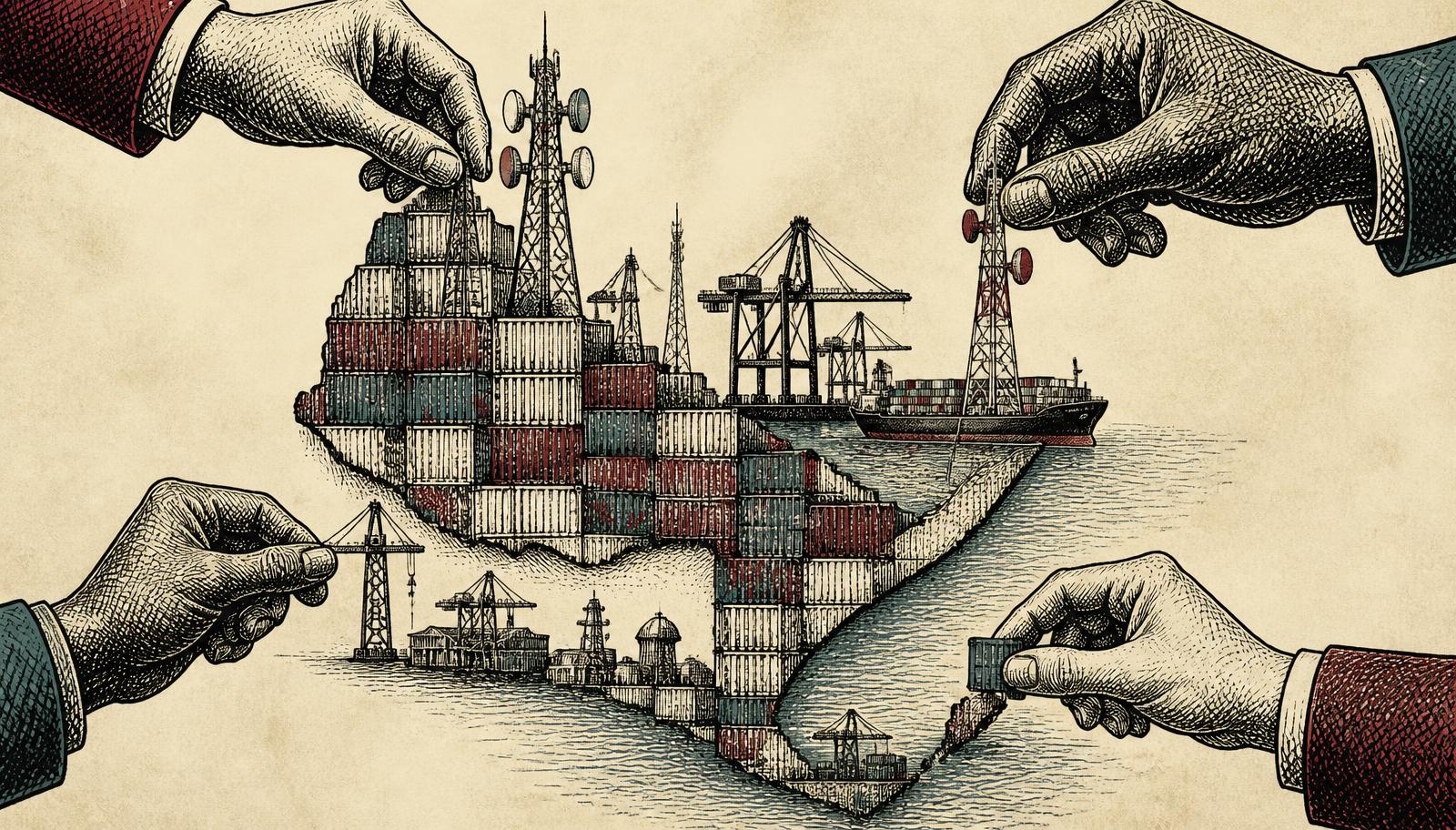
In Somalia and Somaliland, the concern is less about capitalism itself than about concentrated capitalism without sufficiently strong competition institutions. When a handful of large business groups dominate telecommunications, mobile money, remittances, banking, imports, fuel, construction or other essential sectors, they can acquire influence far beyond ordinary commercial power. Smaller entrepreneurs may struggle to obtain financing, compete on price, enter distribution networks or challenge established companies.
The danger is a self-reinforcing cycle.
- Step 1
Wealth
- Step 2
Market dominance
- Step 3
Political influence
- Step 4
Favourable access
- Step 5
Greater wealth
That is not necessarily a genuinely competitive free market. Economists often describe related systems as oligopolistic capitalism or, where political connections determine economic opportunities, crony capitalism.
The consequences can be serious. Small businesses are particularly important in Somalia and Somaliland because governments cannot employ everyone. If independent entrepreneurs cannot grow, the economy can produce a few extremely wealthy companies without creating the broad middle class necessary for long-term prosperity.
It is not enough to tell a young entrepreneur, “the market is open.”
Eritrea represents almost the opposite problem. Rather than powerful private corporations dominating an open market, the state exercises exceptionally extensive control over political and economic life. Private-sector development is limited, and the country has remained under President Isaias Afwerki since independence in 1993. This demonstrates that simply preventing private monopolies does not guarantee prosperity either. Excessive state control can suppress entrepreneurship, investment and innovation just as excessive private concentration can.
Djibouti presents another model. Its location beside the Bab el-Mandeb gives it enormous strategic economic importance. Ports, logistics, foreign military bases and its position as Ethiopia’s principal maritime gateway provide substantial revenues. Yet President Ismaïl Omar Guelleh has governed since 1999. The central development question is therefore not simply how much national revenue strategic infrastructure generates, but how widely the resulting opportunities and prosperity are distributed among citizens.
The common problem: institutions
There is an important lesson connecting these cases. The choice is not simply capitalism versus socialism. A successful economy needs a balance between a productive private sector and a government powerful enough to enforce competition but constrained enough not to dominate society.
For Somalia and Somaliland, that could mean:
- Independent competition authorities
- Transparent business licensing
- Stronger banking regulation
- Easier financing for SMEs
- Anti-monopoly legislation
- Transparent public procurement
- Rules against political favour-trading
Consider a young Somaliland entrepreneur wanting to establish a telecommunications, logistics, food-processing or financial-technology company. If established corporations control infrastructure, payment systems, financing and distribution channels, the theoretical freedom to compete means very little.
The same principle applies to political power. Economic concentration and political concentration can reinforce one another. Businesses may seek political protection, while governments may depend on powerful businesses for revenue and services. Eventually neither side has much incentive to reform the arrangement.
Ethiopia makes the comparison particularly interesting
Ethiopia is attempting something different again: moving from a heavily state-directed development model toward greater private investment while retaining major state enterprises and undertaking enormous infrastructure projects. Its challenge is to avoid both extremes — an economy in which the state controls virtually everything, and one that simply replaces state monopolies with private monopolies.
The most promising model for the Horn would therefore be neither unrestricted capitalism nor total state control. It would be a competitive mixed economy:
Who actually owns economic development?
If GDP increases but wealth remains concentrated among a tiny elite, ordinary citizens may see impressive buildings, ports, telecommunications networks and infrastructure without experiencing meaningful improvements in their own economic security.
For Somalia and Somaliland especially, creating thousands of independent small and medium-sized businesses may ultimately be more transformative than creating another handful of billion-dollar corporations. A strong middle class distributes economic power across society — and, over time, can also make political institutions more accountable.
Reader comments
Share your thoughts on this editorial.